Monday, June 24, 2013

Back to Madrid!

It was wonderful to come back to Madrid with two excellent excuses (apart from visiting friends!):
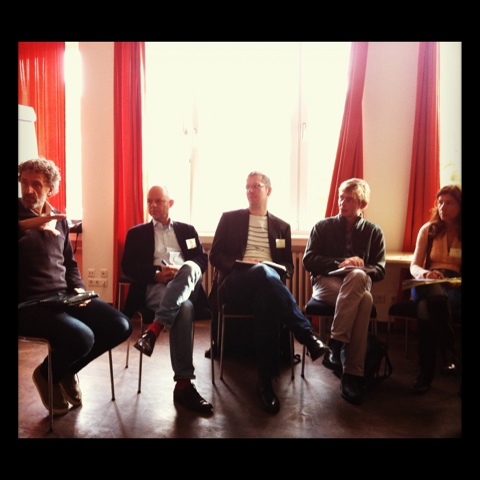
  1. A workshop to facilitate for the HUB Madrid team to support their team with community engagement, community building and participatory leadership/methodologies from Art of Hosting. Check out the graphic facilitation by Toni Arribas (@elreydelaruina). 
  2. My friend's bachelorette party! We cannot come to the wedding in Lima but at least I managed to be part of this special weekend! The photos are beautiful taken by photographer Marianella Fargier.

Friday, June 07, 2013

Orientierungskurs

Finally finished the Orientierungskurs! It was the last stage - three weeks - of the Integrationskurs organised by the BAMF (German Ministry for Migration and Refugees) that supports integration of migrants. It was not mandatory for me to do it, but it was much better than any other normal german course as the people that were studying there were really interested in learning and not just partying in the city of Berlin.

Next stop? The TEST on 13th September. Yep, giving myself some time to study and actually learn as the course is 3 hours for six months, covering levels A1, A2 and B1 and you don´t have so much time to do the homework and study if you are working too! ;-) About the photo, the visit to the Berlin Parliament (Abgeordnetehaus Berlin)!

The BAMF also has a next course that I could do, and this one is totally free, which is German for professional purposes, but it demands a lot more time, 4 hours per day and it ends with a one month internship at a local company. Really useful for people looking for a job. The Germans are preparing themselves for 2030 where apparently there will be a big gap in the professional force.

Friday, May 24, 2013

Civil Wedding

Having two weddings with activities during the weekend with people coming from other cities/continents/countries is one wedding too much. Really. ;-) But after the argentinean one last December, we wanted to give the opportunity for family and friends in Berlin and Europe to be able to come and share that moment with us. It was great and the groom organised most of this one! As the other was my main responsibility, hahaha... It was very relaxed, with drinks the night before at Frollein Langner, a ceremony at the Standesamt Neukolln, brunch at our neighbourghood including loads of live music and performers and finally, a bit of partying for the Karneval der Kulturen. Last but not least, a bus tour the next day for people to discover unusual places of Berlin and lunch at Arkonaplatz.

Wednesday, April 24, 2013

Team Days at A'dam


Simon, Hinnerk, Peter, Chris, Ioana, Vita and myself will be from today till Saturday at HUB Amsterdam on a HUB Global team meeting for the first time altogether in the same city. Its definitely exciting and there is so much to talk about and work on as we usually only work with each other virtually and skype, google hangout, podio and HUBnet are great tools, but at some point not enough to really feel like a team, aligned and understanding where each one of us stands even if working for the HUB in different capacities and schedules. Loads of challenges and opportunities to work on! And we will miss Gail who is in Dubai, Jennifer in Bogota and Gabiza on maternity leave as well as Ruxandra and Dani who recently stopped working with us.

Monday, April 22, 2013

HUB Strategy Gathering


From the 12th to the 18th April I participated at the HUB Strategy Gathering with three hats: co-founder of HUB Madrid, global virtual host for HUB Global on HUBnet and HUB Associate. These are the photos which show in general the spirit and activities but my personal reflections and questions are the following:

  • Needs
    • There is still a big need to walk the talk to being a truly distributed network as many feel we completed the step of decentralisation but not fully distributed...
    • There is a strong focus on learnings. We have made several attempts but still don´t have a platform and visibility of the learnings happening in the network and the steps to being a truly learning network
    • Change is part of life and we are constantly dealing with it, but it is difficult for the team supporting the network as the operational branch to always be changing and feeling that whatever you do its not enough because someone somewhere in the world will disagree and want something else that what was done or what was about to be done
    • A shift in the purpose and dynamics of our gatherings has been voiced, both the Strategy and the Practice ones, as well as an expressed of a constant role to think strategically in the bigger vision, although the current strategy has not enough visibility or does not seem ambitions enough... but who is going to deliver it?
    • There is a lack of transparency towards the whole network (currently the information goes to one legal responsible per HUB) regarding several issues that does not permeate to all team members. Also, there is need for information regarding team members in the HUB Global Team, how are they recruited or why, the selection process and a sensation of "us" and "them" that should easily be bridged by the team engaging daily on HUBnet.
  • Questions
    • Do we sometimes want "everything" investing "nothing? Or little time, energy and resources? It feels like we do. We are very ambitions people with our purpose but in that ambition we might forget about ourselves and the basics of the Maslow pyramid...
    • How much or how little is enough? A constant tension in what actually needs to be centralised and operationalised centrally and everything else that should or could be done locally around the world or in clusters
    • How participatory do we need to be? Another tension is held regarding the different paradigms of organisation and its rhythms. Sometimes we are not participatory enough and sometimes we are when we should not need to be...


Monday, March 25, 2013

Three Movies


Three movies I have recently seen that touch in different ways the topic of the choices you make everyday that configure who you are... Lincoln, The Lady, Argo. Life, politics, activists, people trying to make a difference, authentic and follow their paths... Beautiful three!


Tuesday, March 19, 2013

Qué estás haciendo?

Ahora mismo estoy trabajando al lado de Nele Kaprez, una de las co-fundadoras del HUB Berlín, que está en proceso de ser creado. Los miércoles trabajo con ella y quien se quiera sumar en distintos puntos de Berlín aprovechando para disfrutar y evaluar distintos espacios de coworking. En Berlín hay muchos de ellos la verdad, pero en ninguno se disfruta de la magia que sí siento en el HUB, debido a la práctica, a la manera en que se gestiona el espacio y se cultivan las condiciones de colaboración en su comunidad.

Hoy almorzamos con Boris y Jutta Goldammer, dos personas muy profesionales e interesantes que desarrollaron la Academia de Visionarios en esta ciudad. Se financian con fondos de la Unión Europea y si bien antes realizaban one-off workshops, están cambiando su concepto para realizar el programa durante todo el año. Están también buscando gente para su assistantship.

Esta mañana tuvimos también una llamada con dos israelíes de la organización Leadl que quieren desarrollar una conferencia octubre de este año relacionada con la innovación y el emprendedurismo, creando canales entre Tel Aviv y Berlín, Israel y Alemania. Recién están empezando a desarrollarla aunque ya cuentan con mucho apoyo institucional y de varios emprendedores de alto perfil, por lo que les hemos ofrecido algunas opciones de colaboración y contactos que pueden servirles. Me ha gustado su idea de hacer un Start-up Boulevard.

Por otra parte, está comenzando a formarse un equipo para dar un Art of Hosting training Barcelona sobre liderazgo participativo. Ane San Miguel de Bilbao y Elena Rodriguez Blanco en Barcelona están comenzando a trabajar como "callers" locales y están en la búsqueda de "stewards". Yo estoy acompañándolas y guiándolas en el proceso y me han invitado a ser parte de ese equipo, pero todavía faltan una o dos personas más para completarlo. La idea es hacerlo en Junio o Julio de este año, aunque está demasiado cerca.

Por otra parte, con Richard estamos preparando el taller inTEAMacy para prototiparlo. La gente del British Council y la Fundación BMW a la vez que equipos más pequeños de Berlín han expresado interés, aunque todavía nos queda enviarles una propuesta.

En mi trabajo relacionado con el HUB como anfitriona de la comunidad global, hemos lanzado un concurso con motivo de que HUBnet, la plataforma global powered by National Field cumple un año y ya tiene 5700 miembros de alrededor del mundo en ella. Son cinco desafíos que la gente tiene que resolver a la par que hace posts y comentarios al respecto en la plataforma, para impulsar la colaboración y conexión entre las personas.  También lanzamos el documento de "Purpose & Policy" (Propósito y Política o Reglas...?) para guiar a los miembros de distintos HUBs sobre cómo interactuar y sacar provecho de la plataforma.

Finalmente, esta semana he estado realizando trabajo también como HUB Associate, es decir, como coach/consultora interna de la red de HUBs, con la primera entrevista con el equipo de la ciudad sueca de Södertläje (todo un desafío su pronunciación), que si sigue adelante derivará en ser guía para la realización y evaluación de su plan de negocio, pero que empieza con una conversación sobre su visión y el equipo.

La semana anterior tocó el plan de viabilidad de HUB Donostia, que ya va más avanzado en el proceso de due diligence y han hecho un trabajo impresionante, con el desafío que puede implicar para el gobierno el ser 14 fundadores. A fines de noviembre la red de HUBs votará si pasan a ser una Iniciativa HUB o no, aunque me inclino por lo primero.

Friday, March 08, 2013

CHICLIT

Yep, I admit it. I happen to be a hopeless romantic and love chic literature. I started to read Wilbur Smith at an early age as those were the fiction book that I could find at my home library. His books are about wars and Africa and conflicts, but also about great love and family. Went on to reading the Brontë sisters and Austin among others while studying English as a foreign language.

As an adolescent I came back from a trip to the US with a carry-on suitcase full of Sweet Valley High to learn more "modern" and casual English and stories. Nothing to compare of course, but made a list and lent the books to my also avid friends. I still have those book waiting in a box and I am thinking if to donate them to a library where I could later on share them with my children (when I have and they grow up of course!) or a school... haven´t made up my mind.

More recently, discovered that a former nearby neighbour after having being an accountant decided to try writing and it went very well. Moreover, she is a big success in Argentina where I am from. I am talking about Florencia Bonelli  who writes also about great loves and identity as I talk about in another post of this blog. Her books kept me company in the long flights between Madrid and Córdoba, via Buenos Aires, via Montevideo and via Santiago de Chile! For her last book, the third of the Caballo de Fuego saga, I bought it at the ibook App or Kindle shop, I don´t remember, but it was my first ebook.

Thanks to her monthly recommendation email and also thanks to Amazon, I have discovered three other authors that I enjoy, specially this summer (December/January in Argentina) and later on hibernating at our home in Berlin's winter (February)... Paullina Simons "The Bronze Horseman" saga and Children of Liberty also goes in-depth not only in the story about a great love, but also in how our identity is configured and shaped by migration, the way spaces (both places and historical times) affect the way we are, the way we live, laugh and love.

Finally, I have gone back to victorian times of London and the travels to end of the world with Laura Kinsale. I have read 10 of her books in one month, literally devoured them! All of them do great research and paint with words historical moments skillfully. Her characters are very different and heroes and heroines are blissfully different in the books. Una observación en cuanto al precio de sus libros, en inglés cuestan entre 2 y 5 euros, mientras que las versiones traducidas al castellano cuestan 11 euros!

I have also enjoyed several books by Susan Mallery  specially Fool Gold´s, Dessert Rogues and Blackberry Island collections. Her stories are more similar between each other as she writes several books in one year! And she is the first author I see that has an App. Downloaded it and its quite cool. On the technology side, Florencia Bonelli has a mailing list and she writes a monthly newsletter with recommendations (many of which are from her Editorial obviously) but her Facebook page is managed by one of her best friends, Loti. Paullina Simons on the other hand, manages her own Facebook page and that is a great difference.

Last European summer I read E.L. James "Fifty Shades of Grey" saga. I was intrigued and the books were interesting as I had never considered the issues described there as game between two people with a safeword but her stories are indeed a bit repetitive and not like the other authors I have to say. Yesterday I got a recommendation email about Katie Fforde. Will check her out on the coming weeks!


inTEAMacy

Since meeting Richard Hylerstedt at the SenseCamp at the beginning of February, a month or so ago, we have met every week for one hour and developed the concept we both talked about. We followed a very good chaordic stepping stones process that lead us to define the first draft of the website and proposal for this idea that we called "inTEAMacy". We are just starting but both are passionate on the topics of tRuSt, fEeDbACk and pRinCiPles in teams, still on the way to prototype the first workshop, so looking for volunteers! ;-)
"inTEAMacy offers custom-designed workshops that enable teams to explore and work on the topics of trust, feedback and principles. These crucial foundations of teamwork are not given enough attention and effort in most teams, from early stage startups to task forces in big organizations or corporations.

Workshops organized by inTEAMacy provide a break from everyday routine that is completely focused on taking teamwork to a higher level. Our typical workshop is an afternoon session with careful facilitation, for one or more teams of 3-10 people.

Teams typically come out of an inTEAMacy workshop with an improved understanding of their team dynamics and trust, workable tools for exchanging meaningful feedback and a set of team-specific, co-created teamwork principles.

Download our two-pager to learn more about what we do or get in touch at info [at] inteamacy.com.

inTEAMacy is started in Berlin by Soledad Pons and Richard Hylerstedt, who are happy to bring the concept to where it is needed".


Monday, February 11, 2013

SenseCamp

MakeSense always surprises me. Had good conversations, met again colleagues I havent seen for a long time, met new and interesting people, refreshed some views, confirmed others and enjoyed offering a talk on the 4 elements of trust within the Barcamp, discovering its close relationship with feedback with the group there. Maybe an art of hosting training emerges in Barcelona around June with the chicks (Elena and Clara) from Anoderworld!  More photos here. 


Sunday, January 20, 2013

Wedding Planning

A long blog post to write about this, so many different useful stories to share! Will definitely do in time but the main headlines are: online tools to organize including apps, online suppliers, online invitation management, co-creating the wedding for more participation and ownership of the guests, etc. Natalia Roca documented with photographs. Some photos by friends also.

General

Grafica
Decoracion
Novia
Cotillon

Wednesday, December 12, 2012

Citizens For Europe

Incredible participatory workshop for Integration Officers around Europe that I cocreated and co-hosted together with the Citizens for Europe team! Find documentation/harvest here along with stories, fotos, best practices, etc. And the new website with the video and all resources!

The “INTEGRA Seminar” has been initiated, organised and funded by a joint partnership of organisations active on local, national and european levels: Citizens for Europe e.V. (CFE), Friedrich Ebert Stiftung (FES), the Integration Office of the district of Berlin Tempelhof-Schöneberg, British Council, European Network Against Racism (ENAR) and the EU Fundamental Rights and Citizenship Programme.

The event brought together 16 practitioners working in local administrations (integration officers and politicians) from Germany, Hungary, Ireland, Luxembourg, Macedonia, the Netherlands, Portugal and Switzerland, who met in Berlin on December 6th-7th, 2012 and worked together for two days on
how to achieve a more inclusive society with integration and diversity policies.

Tuesday, December 11, 2012

Weekend in Paris

Even though we tried not to travel too much the second half of the year, its always great to go back to Paris! And more if its to visit family... Musee du Quai Branly, an exclusive visit to Luxluxlux atelier and other interesting stuff... More photos here.

Sunday, November 04, 2012

Berlin Change Days


At 4 pm on Friday the two-and-a-half-days gathering called "Berlin Change Days" related to Change Management started with a presentation from Holger Nauheimer on the Changing Ecosystems of Organizations and Companies. Even if I have purposelly "withdrawn" from the event scene in Berlin (there is so much going on in the city that if you could only dedicate to attend amazing events with too much stimula and not focus in your work at all if you are not careful) I chose to attend this particular event as a special learning experience for me.

My desired outcome was to use this moment to learn selectively and I am happy to have achieved it, although in the beggining I was afraid this would be yet many conversations maybe taking nowhere. I take away several valuable tools I didnt know before and that I cannt wait to have the opportunity to start using them and I think I will start at the INTEGRA Seminar for Citizens for Europe (will be working with integration officers from Europe that want to change... rings a bell?).

I think they will be truly useful both in my work as a freelance facilitator, trainer and project manager, as well as for my work within the HUB Network ("where change goes to work!"), which is called Global Virtual Hosting members and is mainly focused on community managing the global platform of 5000+ members and keep the knowledge flowing across the network of 200+ team members.

Some of the topics, ideas, thoughts or quotes I would not like to forget and would like to come back to in the future are harvested here:

Virtual is the norm?
  • 5 principles of the new ways of working to trust: 1) Trust your people, 2) Reward output, 3) Understand the business case, 4) Start at the top, 5) Treat people as individuals. Maitland/Thomson, 2011.
  • Do you want commitment or compliance? You could micromanage, but what for? Is you work location or time dependent or independent?
  • Bene.com offices of the future, study on new work spaces.
  • All people have purposes, concerns and circumstances, many things are not only resistance to old habits. Time to adapt.
  • Change management has become a commodity. History of change. Meaning quote by Umair Haque.
Clean Space Process, Wendy and Wendy Nieuwland.
  • Facilitating change in organizations. Space is an intrinsic methasphore. Embrace the power of space. 
  • Change the perspective, the experience, the way you think.
  • It is a very structured process of 6 or 7 steps where you have the different levels of the individual to the group conversations. 
The People Side of Change, Chris Perillo.
  • She took us through a really good and energetic workshop where we started by differentiating change from transition, topics I had been deeply involved in in 2010 and hadnt had the time to reflect about in perspective.
  • She also gave us some tools from William Bridges "Managing Transitions".
  • We talked about resistance and reactance responses, what makes people want to change, coaching to influence change, the Force Field Analysis/Action Matrix and the Stop, Start and Continue.
Developing Collective Competence, Doug Gilbert.
  • Although a bit old school in terms of just presentation and little time for interactions, we did speak about the importance of paradigms in facilitating change in organisations.
  • And competence as the collection of knowledge, skills and abilities needed to manage the shared understanding of an organisation or the organisation´s reality.
  • Three dimensions to it: life world, social construction and understanding drives behaviour.
Trust in Virtual Teams, Jouke Kruijer and Holger Nauheimer.
  • The most intresting one for me in terms of everyday work of a distributed team in different cities in the world.
  • Where does TRUST comes from? It starts with perception on appearance, gender, voice, the way you move and ground yourself, the things you say.
  • Richness vs leanness in communications to build trust
  • We often see that we have different personalities when we work online with people!
  • Everything that is a problem face-to-face is magnified in the virtual world
  • It takes an extra effort to build trust virtually, the mechanisms are different
  • There is a relationship between TRUST and safety
  • TRUST is also reciprocal
  • TRUST comes slowly and goes easily
  • Three kinds of trust: 1) Swift trust: task based. You need to have it and you start trusting because you have no choice to work and deliver something but if you dont meet expectations you are out of the team quickly, 2) Cognition-based trust: is more mid-term, do you know what you say? 3) Affect-based trust is long term, there is a relationship.
  • Frequency of meetings as well as tools and ratio of virtual vs personal meetings are important
  • Exercise of the hands and looking at each other in pairs: it works for the most improbable groups
  • Try meetings with funny hats, Christmas party virtually. Do the crazy things!
  • Spending time checkin-in first really pays off
  • Do we know all the media tools? They are the 10% but can really screw-up everything else if people dont know how to use it
  • Slide about the virtual office and its componens: the meeting room, the shop floor, the water cooler or coffee corner, 
  • My contribution: Exploring the links and dependencies of our work together at first, having a check in day where you know other may need to talk to you and you need to talk to others once a week instead of eternal thread of emails, no news is good news? Taking notes when talking on skype not to fall asleep if its a multiple-people conversation. There are four elements of TRUST and the way we prioritize them will make us have a completely different way of trusting than another person: Coherence, Consistency, Flexibility and Transparency.
  • Creating patterns and rhythms of interaction
  • Virtual Leadership
  • Work on being vulnerable in virtual teams
  • How do you deserve TRUST? Trus in distributed teams: determines my engagement, impacts on team performance and contributes to well-being.
  • David Maister formula of TRUST equation: Trust = Credibility + Reliability + Intimacy / Self-orientation (the space that you take at the cost of others, the ego).
On the logistic side of the organization and as this was my first time at this conference and at this campus, I would suggest that the breakout sessions program and rooms are included in the entrance of the building or outside the main room also and not only inside, as it was very difficult to see if one could not start in the beginning with everybody. A description of the sessions at a board/poster on the wall to choose (if you could not hear the pitches) would be perfect too. I also didnt know that the lunches on Saturday and Sunday were not included, that was a bit weird. Other than that I enjoyed the facilities, good location and everything went smoothly. Now that I am writing I also realize it would have been great to have a convergence session or debriefing session where we could share what we had learnt or experienced in the different session and thus "cross-polinize" our learnings. I would have only one or one per day at the end of the day. Maybe it took place and I wasnt there as I could not stay till the end due to work commitments unfortunately.


Sunday, September 30, 2012

Practice & Innovation


The first Practice and Innovation HUB Gathering in Sweeden was simply amazing. The team has produced a huge and rich Prezi. It has been incredible to share all these days in the island of Ekskaret three hours away from Stockholm with colleagues from around the world, as it alway is a pleasure. More photos  here! And short videos here. The only bad news were that my phone fell into the water (with me) and iphones do not like water let me tell you...

Sunday, July 29, 2012

Kayak Saturday!

El sábado alquilamos kayaks en Treptower Park y nos fuimos a celebrar el cumpleaños de una amiga por el río que atraviesa la ciudad de Berlín: el Spree. Queríamos llegar hasta el lago llamado Müggelsee (unos 13 km) porque dicen que es super lindo para bañarse, con playita y todo, pero con nuestros brazos no entrenados no lo logramos. Creo que sólo llegamos a 8km. Descubrimos lugares interesantes en nuestro camino, hicimos un alto en un jardín secreto invitados por un grupo de gente que vivía allí y también un picnic en el medio de un lugar abandonado. Fotos por aquí!

Nos bañamos, nadamos un poco, nos llovió encima, y muchas cosas más! Pero estuvo precioso la verdad y me dí cuenta finalmente de que por más que extrañe mucho Madrid, es cierto que Berlín va mejor con mi personalidad, con lo verde de la ciudad, con el mundo star-up que existe acá, y la accesibilidad de este tipo de actividades que disfruto mucho! También fuimos y volvimos en bici, por supuesto, unos 7 km cada trecho sobre bici-sendas con semáforos incluidos. ;-)

También se pueden hacer tours de Berlín en kayak! Mirar acá.


Friday, July 20, 2012

Berlin Spaces

This is a list of special places I have gathered for a friend who was coming to town with professional but also personal purposes. A list of places that would interest a #socent, or social entrepreneur in a way, people interested in spaces that enable change, and also other just cool spaces and activities. In no particular order!

Wednesday, July 18, 2012

Cine al aire libre!

El cine al aire libre, o freiluft kino, es un clásico en Berlín. Este verano ya fui al menos tres veces y es simplemente maravilloso. Buscás tu silla, la acomodás donde querés, podés traer tu picnic o comprar en el barcito local, y ver una película bajo las estrellas.

Es increible que no sea tanto una tradición en España o Argentina donde llueve un poco menos que acá!!! Bueno, si, en Madrid está el cine de verano del Cine Doré de la Filmoteca Española sobre la terraza de un edificio en el centro o el Open Air Madrid al sur de la ciudad en el parque Tierno Galván, pero me refiero a cine en el medio de un parque en el medio de la ciudad. ;-)

Las tres pelis que fui a ver hasta ahora son:
  • También la lluvia: Buenísima, pero todo un shock, claro el tema no es para "pasar el rato". Sobre Latinoamérica y la colonización, un film dentro del film donde lo que relatan en la película que realizan los protagonistas se va reflejando en la realidad del día a día...  Luego me enteré que estuvo Isidro Terraza en la producción!
  • Barbara: Una médica que aplica para salir de Alemania del Este y es trasladada de Berlin a un pueblito en el que planifica su escape...! Lo logra o no lo logra? Tiene completamente otro ritmo y me encantó conocer un poco más sobre cómo vivía en esos tiempos. Apenas me mudé a Berlín no quería saber demasiado, porque es tan pesada toda la historia que se vivió acá, pero de a poquito voy incursionando y si es con una película, mejor...
  • Medianeras: Sin palabras! Fui pensando que me iba a encontrar una "tonta" comedia romántica (de esas que amo por supuesto) y me encontré con mucho más! Una reflexión profunda, narrada de una manera preciosa y con una fotografía impresionante.

Friday, June 15, 2012

Mediation Conference

Yesterday I had the pleasure to facilitate a session for the 2nd European Mediation Conference organized by the International Mediation Alliance with the support of the culture.communication. The goal of the conference was to enhance the development of cross-border mediation and to expand its consisten use accross Europe to solve conflicts faster, more effective and more cost-efficient than at conventional judicial proceedings. Amazing!

I was invited to host a networking session as that was what the participants were craving for and didn´t get in the first conference a year ago in Italy, so I thought of a way o making it happen without it "just being a business card party", but more a space to connect and interact around things that matterd for them at that moment. This is what I came up with after remembering a greographical walk talk with colleagues at the Art of Hosting Berlin in 2009. To me it was a great experience to work with people that don´t usually use art-of-hosting-like methodologies and processes, and I think the participants enjoyed it too!

Monday, May 28, 2012

Karneval der Kulturen


This weekend we enjoyed the Carnaval of the Cultures: A four-day carnival that celebrates different cultures in Berlin, an amazing opportunity to see and live the cultural richness of Berlin, highlighting the hidden treasures of its international cultural scene. Apart from a 5 or even 6 hours parade on Sunday, there are many stands of arts and crafts as well as international food and beverages, and 4 different stages (Latinauta, Bazaar Berlin, Farafina and Eurasia) to showcase the music rhythms from around the world. A wonderful experience lived for the first time of many I am sure! Some blog posts in Spanish here and here, another one in English and my own photos here! Videos from the organization on Vimeo from other years here.


Global Virtual Host?

Today I had a great interview with Gabriela Albescu and Simon Ulvund about becoming global virtual host for the network on both, the global platform and the practice platform. It would be a part-time position on top of the Hub Associate as an internal consultant for the network.

They made some very good questions and it was interesting to try to answer them, because of course it being a first approach to the different issues:
  • What excites me about the position? For me its about taking what we do to the next level, the global level which many members and teams have been requesting for some time now. Its about serving two different "clients":
    • Members from Hubs around the world:  Need to know what is going on in their field in different countries, search with suppliers or partners, connect with other people to have more impact or to find out better ways to address the issues they are addressing with their projects, etc.
    • Teams from Hubs around the world: Need to have access to the knowledge and best practices in an easy way, hosted into the tools already there while also fostering new practices coming along. A space to unleash the learnings within the network
  • Which are the projects you would work on?
    • Connect, understand the dependencies and create the links with the Management Team, the Practice Coordinator, the HUBnet/Tech manager, and the Communications expert as well as this work needs to be aligned with all of them and the internal/external communications strategy.
    • Also, identify the local representatives of Hub teams, generate the contact and the rhythm of engagement with them at different stages of the pipeline (once they are initiatives) but evaluate the needs from the imagination stage as well.
    • A concrete project would be to map the members and the teams in Hubs around the world to understand what their needs are so that we can provide quality in the connections and content.
    • Members have been wanting to meet physically in a gathering for some time now, it would be fantastic to create a members world gathering for 2013!
  • What does success look like? I would need to know the exact needs, strategy and prioritization (its a part-time position so far!) that we agree on but I think that I will feel I have succeded if everything is flowing in the platform without me being everywhere or having to post everything. If people are hosting themselves and each other virtually, if there is less of me and more of others there.
  • What are the challenges? Time availability of people, both members/entrepreneurs trying to run or develop their projects and team members. Also to respect myself the part-time commitment to this and not go over the top.
  • In terms of practice, what are the practices that you see relevant for the next stages of the HUB? The two that are being mentioned more are: incubation and education. What I wonder is that there are so many programmes of this type and organizations that do them, that I´d like to explore how our offering would be different from others...

Sunday, May 27, 2012

Graphic Recording

Landed in Berlin on Thursday and for the past two days I was in a graphic recording workshop at K Salon: the reason I had to come back so quickly and could not stay in Myanmar more time. Anne Madsen,  a kaos pilot graduate from Denmark who works professionally on this, was facilitating the workshop and we (art of hosting and art of transformation lab friends) co-organized it.

I have to say it had a perfect mix of teaching and practice, a perfectly designed two-day process where you, even if you were jetlagged, could make the most of it. There was a good mix also between the individual work, in pairs, groups, table or the whole room as well. Here are more photos!

So, I was the shy type when requested to draw as a child, but we got in touch with our child memories and departed from there (I remembered that I always used to draw ponds with water and trees/mountains around, what nature means to me I guess...). Since 2008 when I got to know of the company Xplane (love their discovery cards!) with my Hub work, I have wanted to work on this: making the complex simple by visualizing it in drawings with icons and sketches. This work also comes from infographics in media that had the same purpose.

We started with a check-in, moved to the purpose, outcome and principles of it and got to know of the differences between visual recording, visual strategic communication and graphic facilitation. The first one involves harvesting, while the second working with a team for them to use the tool afterwards and the third actually to facilitate a workshop (the one that needs mastery to be able to do everything at the same time: guide the process, make the good question and cristalize it visually at the same time). They all need practice though!

We also played pictionary and learned from that experience. We drew our life stories and also worked on a personal project. Part of the learnings was to listen in a structured way, listening for different categories or concepts to later put in images. We created an icon library with words proposed by the group that were important to us: co-creation, purpose, collaboration, among others. Wonderful experience which I hope to use in my everyday work! Some ideas I´d like to keep in mind and that also come from design/communications:
  • The way we read images in each culture is similar to the way we read text, and we need to provide a clear way of reading it!
  • Reach clarity yourself before drawing to be able to make complex things simple
  • Give "air" (white) to your images letting the eye rest in some places
  • Provide a frame to your drawings, it grounds them
  • Include a main headline and also smaller ones (not more than 5-6 per poster)
  • Color-coding: Using the same colour for similar type of information. 2 or 3 colours are enough.
  • If you have time, you can use post-its first and then draw the complete thing
  • Balance: There has to be balance between icons and text (content is the king! but visual the queen!)
  • Templates: Its good to use them, some can be more static or descriptive or more dynamic or action-oriented (depending on the type of work and meeting)
  • Practice practice practice!
  • Choosing an angle: Stories are not linear so chosing a structure is important to thread the story/topic.
  • Cheat! Yes, in this discipline its ok to cheat, give and take, re-interpret, etc. There are loads of icon library resources... :-)

Friday, May 25, 2012

Myanmar Tourist


On Wednesday after lunch Debasmita Dasgupta (find her blog here) and me managed to get to the Shwedagon Pagoda, one of the biggest, oldest and most impressive ones that we could just not visit. It was great because being the two of us only we got to talk a lot about ASEF where she works and about media convergence in general as well as social media coverage of social entrepreneurs. Here are some of my photos, but if you´d like to check out hers here, they are much better with a good camera (and eye!)! Even if it was really hot and we were tired, it was amazing to whitness the peace in this place and the way people enjoy it, either praying, reflecting, talking to mates or even having a siesta!

The entrance to it is 5 USD and you have to take off your shoes to get in the premises as well as have proper length in your clothes. The back of the ticket you can read this: "The origin of the Shwedagon Pagoda materialized in brillian epoch in Buddhist history over 2500 years ago. In India, Prince Siddhartha had just attained Buddhahood when he was visited by two brothers Tapussa and Bhallika, merchants from Myamar who offered a gift of honey cakes. In return, the Buddha personally removed eight hairs from his head and gave these to the two brothers for enshrinement in their native town of Okkalapa which is now the City of Yangon. On their return, the two brothers presented the Buddha´s hairs to the King of Okkalapa who erected the pagoda and enshrined the eight hairs together witht he relics of the previous three Buddhas.

The original height of the pagoda was 66 feet. From the 14th Centruy onward successive monarchs in Myanmar rebuilt or regilded it until it reached its present height of 326 feet. It has ten unique different sections, namely, the base, the three terraces called "Pyisayan" the "Khaung Laung" so called because of its bell shaped, the "Baung Yit" with distinct embossed bands, the "Thabeik" (monk´s food bowl), the "Kya-lan" an ornamental lotus flower, the "Hngnet Pyaw-Bu" (Banana Bud), th "Hti" (Umbrella), the "Hngetmana", the flag shape vane which revolves to the direction of the wind, and the Seinbu (Diamond bud). The "Hti" and the "Hngetmana" and the "Seinbu" are decorated enlaid with 3154 gold bells, 79569 diamonds and other precious stones". The video is not mine but it definitely shows what this place is like!

The following day we departed back to our homes, transformed by the experience and with good ideas to think about and implement. I enjoyed the ride to the airport with Jacek from Poland (Klub Gaja) and Mogkol from Thailand (the papas of the group as per Anton´s saying!) as well as Orapin from the same country who had just gotten a new land for her project: Kokoboard. We enjoyed some good expresso at the airport and the last few conversations! Usually I don´t enjoy so much talking to people on planes anymore, I use it as my thinking/reflecting time, but this short flight to Bangkok I did have an amazing chat with Niels W. Guenther from the Three Diseases Fund from UNOps. Nice to meet you all and let´s see when our paths cross again...

Wednesday, May 23, 2012

Myanmar Day 3

On the third day, I had offered to Tristan Ace and Mi Mi Myo Win organizing this event to facilitate a process to help the group reflect, plan some actions and build community around social enterprise for impact. After meeting Kathrine Rasmussen from Action Tank in Denmark on Monday I invited her to co-host these activities with me and it was grand to work with her. We both hoped to have other opportunities to host together!

We started outside with a short check-in to arrive and share our dreams with a few people. You can see the Pro-Action cafe process and harvest here. And some photos from that awesome morning! Some media repercusions of the whole event are to be found in The Nation and Myanmar Times. It is exciting to whitness and be part of a country in a change process! Thankful to the British Council and ASEF for the invitation!

Tuesday, May 22, 2012

Myanmar Day 2

On the second day, people from the British Council and different organzations/companies/institutions from Asia (Myanmar, Indonesia, Singapore, Thailand, Phillipines India and Vietnam) and Europe (Denmark, Sweden, Poland, UK and Germany) gathered again at the British Club to start the activities around four different tracks: education, public health, environment and tourism and heritage. More photos here!

We did informal visits during the day so that we could reflect about the social opportunities and challenges in Yangon proposing enterprising solutions. We were taken around the city to understand the sector and by the end of the day we presented some ideas to local potential social entrepreneurs and emerging leaders.

I was attracted by the Education track but finally chose the Tourism and Heritage one encouraged by Tristan Ace. Our hosts were Shun Lei Swe Yee and Cham Tha Kyaw. We started with a meeting at the Yangon Heritage Trust at Kandawgyi tower, a recently formed group who are currently working on how to preserve the colonial architecture in Yangon. The group is led by Than Myint U, a leading historian.
  • Some thoughts on this:
    • Buildings from 200 years ago are well protected, mostly religious sites, but buildings from 1960s are not and this is what they would like to focus on
    • They need government regulations for urban planning
    • There are not enough technical skills in architects/builders
    • They will have a hearitage conference in June to formulate the way forward, bringing people from abroad, trying to combine the new with the old
    • When seeing the buildings we realized that some of them are not in use, some are in use by official authorities or companies, and some are being used as normal houses so the motivations for this three different type of users to maintain these buildings will be different
    • What about the intangibles of heritage that needs "protection" and that are not buildings?
We also visited the Bogyioke Market briefly and we did a walking tour of Pansodan Road, discovering the best examples of colonial architecture in Yangon. We also went to Latha Township (China Town), one of the most energetic areas seen as with great potential for tourism. We saw many things that social entrepreneurs and the government could start working on right away:
  • Community-based and eco-tourism (example from Madrid: Alice Faveau from Focus on Women)
  • Lowering property taxes to people and companies that mantain their buildings properly
  • Renovate one as an example creating value to local community
  • Make video mapping and documentation to give visibility
  • Create a good quality yet cheap taxi meter to sell to taxis-owners for tourists not to have to negotiate every trip
  • Do something about trash recycling as currently trash is on the streets, very near food and where people live daily
  • Riverside development: Currently the city turns its back to the river, they could open it more and make it a place tourists would like to visit!
  • The main important thing we see is to be having these conversations now to be able to face development with the right tools instead of just doing it as in other asian countries, there is a lot to learn from their experiences!
  • More ideas in our presentation (will include the link when I get it)
For some reasons I thought it would be great if these guys got in touch with Jessica Chandler from Cinema for Peace Foundation (for the video and documentation project) and invite the Hub network´s architects and interior designers (Cristina Rebolo, Andrea Paoletti, Oliver Marlow, Josemaría de Churtichaga+Quadra-Salcedo) to the conference in June although their agendas might be full already!

Monday, May 21, 2012

Myanmar Day 1

By the end of the first day (out of three) of the Field Learning and Networking event for social entrepreneurs at Yangon (Myanmar/Burma/Birmania) organized by the British Council and supported by ASEF, I have run out of my Moo business cards and that can be not-so-nice in an asian country where there tradition is to exchange them in a very respectful way, with half a bow, reading them carefully, asking questions and understanding more about what the other person does.

The good news is that I have met today so many interesting people that where worth exchanging cards with! I gave the last one to a lady from PSI Myanmar, a global health organization dedicating to improving the health of people in the developing world by focusing on serious challenges like lack of family planning, HIV/AIDS, barriers to maternal health and the greatest threats to children under five, including malaria, diarrhea, pneumonia and malnutrition. She has been here for two years and has whitnessed the transition that this country is undergoing. When asked by other people if she had seen the docummentary "Burma VJ", she answered negatively as they still don´t have access to some content here.

During dinner, I found about two different projects but somehow related: Action Tank from Kathrine (Denmark) and Future City game from Andreas in Sweden trained by the British Council in Warsaw to be a Game Master. The Future City game is a team-based process designed to create new thinking and actions to improve quality of life in cities. Both KaosPilots graduates (an innovative university if you haven´t heard of it) and driving amazing initiatives in their countries and beyond! We were also dining with Bodil (Sweden) who shared the project-management she is doing for Radio Totalnormal a radio that was inspired by La Colifata in Argentina, although it has its differences with it.

Earlier this evening at The Strand Hotel I met a HUB Seattle member, Pwint P. Htun, who is from Myanmar originally but lives in that northamerican city working in technology, and is looking forward to exploring how and with what projects to come back to her home country. I also shared my situation with coming back to Argentina, that I am in the same exploration, but it will probably take several years as I wanted to engage with the city of Berlin where I am living more. Pwint and Kathrine shared an incredible initiative by the city of Seattle! They will open a Food Forrest in the city, do follow the link and read about it because it seems like taken from a fairytale (Beacon Food Forrest).

It was also interesting to meet Prof. Dr. Aung Tun Thet, Senior Advisor to UN Coordinator´s Officer, who was also involved in the launch of the Global Compact UN initiative in Myanmar this same month! It was fun to hear him say that many people think they are social entrepreneurs but they actually are not... to which I replied that in the Hub network we are trying to transcend the terms social enterprise and social innovation as the entrepreneurs themselves sometimes don´t identify with those categories or denominations. ;-)

I was invited to represent the Hub Network with a short keynote speech about "Social Enterprise in Transition", which I gladly did sharing what we stand for, the vision, purpose and values, as well as the transition we had undergone for two years and how each one of us in the network had to hold space for some time letting things emerge so that the network had the distributed governance model with the legal and financial structure its members wanted from the start. Finalized by referring to what I personally think is the leadership type that we need in times of transition, moving from heroes that need to predict and make decisions on their own, to hosts that enable people and let things emerge in co-creation and collaboration. It was interesting that the BC Director, Alan Smart, really digged into "ordinary people doing extraordinary things".

During the day, I shared a lot of bus (lovely kept and with purple curtains by the way) conversations with Rambie Katrina R. Lim from Manila in the Philippines. She was full of energy and ideas about sustainable fashion and design, with many projects already in place (one of the being Tepiña, luxuriously green) and some on her head as well. I got to know about the pineapple fiber they use in some traditional outfits (saw some truly beautiful photos in her mobile phone) and update them to modern design but keeping the traditional weaving. I suggested that she should check out the IOYOU project as the work they are doing with the Madras fabric in India is totally amazing! She suggested that I should check-out the Invisible Sisters work, when talking about waste management as they are re-using plastic bags to create new things. Did you know that the potato starch bag so trendy nowadays takes 10 years to degrade? Not so biodegradable as I thought...

So, this first day was exactly about that, meeting the participant´s of this event initiatives and also visiting two local ventures: FXB in the morning and Proximity Designs in the afternoon. Both have quite different models but were very intelligent chosen by the organizers as their impact is inmense. Interesting enough, both are associations in legal form and not a for profit company.

The very passionate lady from FXB showed us ever room in the building and explained the various programmes they have, in so many levels of society: men with woodcrafts and iron, children with HIV through non formal education, adolescents from 16 to 20 who sow for a living, young people with drama classes and sex education and women also with diverse issues to weave and make beautiful threads. We later visited their showroom, shopped too and experimeted total heat+humidity as got to know first hand that people here have maybe 3 or 4 hours of electricity per day, so you hear the power generator noise everywhere near the buildings.

The second project we visited was Proximity Designs. We were welcomed by David Klaus and Todd Murphy, in charge of design and production respectively. They made a very interactive presentation (we could not stop interrupting to ask questions!!!) and started explaining that a well designed product can have an impact in our lives, so they design, manufacture, distribute and sell affordable products that have to do with water access (pump), storage (water tank) and application (drip irrigation system). Their products cost in retail between 17 to 50 USD! And the make possible one-person farming (a huge change from two people as one of the family members can farm and the other one run errands, take kids to school, etc.)

Their focus is on quality (as they believe many of the products at the BOP -Bottom of the Pyramid- usually are cheap and not durable. The purpose? To address poverty by actually increasing the income of their customers, because that is what people are for them, not charity receivers. They never give away their products for free but sell them at an affordable cost for their customers (if a price is to hight they inmediately receive feedback from their customers!).

They manage to cover the costs for the production and distribution, but they also need to fundraise to maintain the whole organizational structure, specially design and overhead. There is two dedicated staff to fundraise. Between the design team, people working in the manufacture, logistics (dealers, agents and demonstrators) and impact, 900 people are involved and that is only in the products department. They have also other areas of work like Relief, Microfinance, EAS, public policy.

They mentioned that they don´t have an IP (intellectual property) strategy yet, but they have been thinking about it. I personally think it would be great for them to have an open source model, or a freemium one where you get a design toolkit if you pay a small fee, so they would actually increase their impact providing quality at an affordable price with some legally binding conditions to the ones that would use this for example. But I am no legal expert so its just an idea! They are always looking for talent so if you know anybody from Myanmar, do refer them!

Friday, May 18, 2012

Hub @ Vision Summit

 Today I was part of a lunch at the Vision Summit in Potsdam about the HUB. It is one of the most improtant events in the world about social innovation, social entrepreneurship and social impact business, but it is held in German so I did not take part of the whole event. Hinnerk Hansen (Hub Vienna) and Christoph Birkholz (Hub Zurich) from the nearest Hubs and both german speakers themselves, hosted a session about the Hub Network and the transition it has undergone in the past two years.

They also introduced the new local teams in Germany! Carina Lugert (Munich), Nele Kaprez (Berlin) and Martin Herrndorf (Cologne). There also is a team in Hamburg under consideration. It was great to meet them and hear from them as well. The topics or questions addressed are similar as similar are the stages they are at, so I offered my support as Hub Associate (we are the internal consultants that can support the teams beyond the formal support they get from the HUB management team and the their sister HUB. Here are some photos!


Monday, May 14, 2012

Prezi for Myanmar!

So Power Point Presentations (with capital Ps) are last era, but not everybody loves Prezi yet. I started using it last year for the TEDxBarcelona conference in July, and now I need it again. I say I need it because it is specially useful when you are planning a presentation in another country, where you don´t know if you will have the mac plug for the projector (I should own one by now!), or if you will have internet, which version of Power Point you have, if your presentation format will change with it, etc.

Having a Prezi makes a real difference in these cases. At least for me. You completely forget about all issues of things being compatible. It is a total white canvas (you can use templates if you´d like) that scare some people but for me this represents endless possibilities! Yes, its a little overwhelming when you just want to achieve a 10 slide presentation of the old type. ;-)

I found an interesting tutorial in video here by Tosolino, who teaches you very simply how to include a "call to action" in your Prezi with the specific font you´d like! (a one bad thing about prezi is that there aren´t many font options... uhhh). For this one the phrase will be "#socent in transition" as Tristan Ace from the British Council in Myanmar decided to name my keynote speech for the first night of the Asia-Europe field learning and networking event that will take place in Yangon next week, and where I am very excited to participate for many reasons! This country in Asia has been under a huge transition for the past two years and everybody is mentioning the amazing opportunity it is to be able to visit at this moment, a moment where Thailand was 30 years ago as people say...

I love that the event will not be a regular conference and that we will actually not be in a conference setting everyday, but mostly in an experimental and practical setting, visiting social enterprises there and sharing experiencies from different countries in both regions. Also on the morning of the 23rd I offered to host a Pro-Action Cafe to let people present a topic/project they would like to address during the morning. Something that they would really like to see surfacing is a social entrepreneur network in East Asia. Let´s see what happens! Some little big steps in a country where a transition has been taking place over the past year.

Friday, May 11, 2012

Carnet de Conducir

Ya se que es un post aburridísimo, pero lo escribo por si a alguien le sirve tener esta información ya a mano en lugar de tener que perder tiempo buscándola. Es el turno ahora de la licencia /el permiso / el carnet de conducir!

Para empezar, de nuevo fui a parar al artículo de Berlin en español que habla del tema y me encontré con lo siguiente:
  • Una vez pasados los 6 meses de residencia y para los latinoamericanos como moi, es preciso solicitar el permiso alemán a tarvés de una escuela de manejo
  • Al tener el carnet anterior y saber conducir, no es necesario hacer el curso práctico, pero sí tomar algunas clsas para familiarizarse con las leyes de tránsito e instrucciones durante el examen. El examen práctico se da en alemán y el teórico puede rendirse en castellano
  • Es necesario tener: traducción certificada de la licencia anterior, realizar un curso de primeros auxilios y un examen de la vista.
  • También hay que llevar el pasaporte y una foto claro! 
  • Me informaron de que comenzar desde cero para tramitar una licencia cuesta aproximadamente entre 1200€ y 3000€.
Voy a averiguar como es mi caso al ya tener el carnet argentino y manejar desde los 18 años con Farhschule Amigo y con Autoescuela en Berlin (10 a 18 en Strommstr. 59, 030 39741089) para ver cómo son los pasos y cuánto cuesta realmente. Leonardo de Autoescuela en Berlín dice lo siguiente:
  1. Registrarme en una escuela (incluye 14 hrs de teoría) y hacer el contrato con ellos: 80€.
  2. Ellos te derivan con alguien que hace traducciones de licencias certificadas alemán/español (aprox. 40€) y te dicen con quién hacer el curso de primeros auxilios además del examen de la vista (todo por 25€).
  3. Luego debes ir a aplicar al Bürgeramt con el contrato de la escuela informando de que uno ha comenzado el proceso.
  4. El cuarto paso es empezar a estuidiar la teoría, que se puede hacer con una plataforma online en castallano: 40€.
  5. Realizar el examen teórico (que va antes del práctico y son 940 preguntas). Aparentemente poca gente lo pasa la primera vez: 20,83€. Fharschule kart o learn system o algo así... no entendí bien por teléfono.
  6. Hacer unas horas de práctica con la escuela, en este caso un mínimo de 3 horas con el instructor para que me evalúen (25€ x 3 = 75€).
  7. Realizar el examen práctico en alguno de los dos institutos, Dekra o Tüv (este último dicen que es más flexible): 85€.
  8. Finalmente se vuelve al Bürgeramt y se presentan todos los papeles. En total unos 450€!